-.-
Mohave Point
 -
- 
 -
- 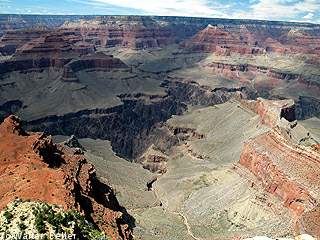
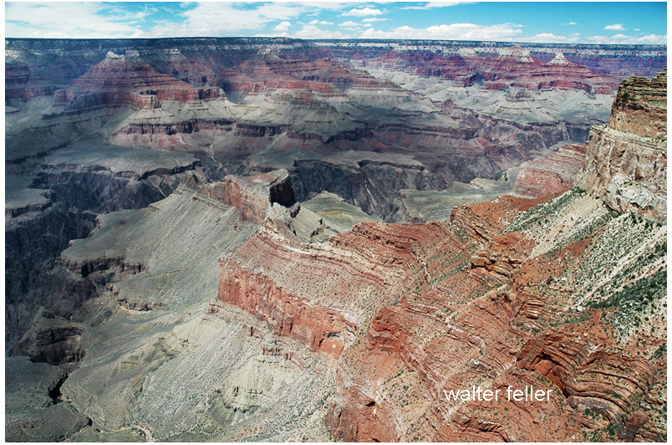
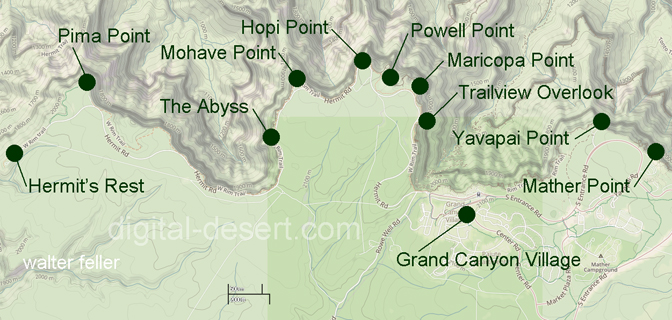
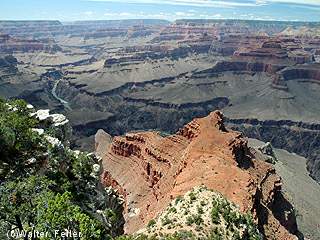
Mohave Point occupies one of the most commanding positions along Hermit Road on the South Rim of Grand Canyon National Park. Set on a projecting promontory west of the central village area, the overlook provides an expansive panorama into the heart of the canyon, with the Colorado River visible far below among shadowed cliffs and ancient rock formations. A short paved path leads from the shuttle stop to the main viewpoint, making the overlook easily accessible while still retaining a sense of isolation above the immense inner gorge.
Mohave Point is especially valued for its western exposure. Throughout the afternoon the angled sunlight reveals extraordinary detail across the canyon walls, illuminating terraces, side canyons, and detached buttes in alternating bands of light and shadow. By evening the overlook becomes one of the South Rim's principal sunset destinations. As the sun lowers toward the horizon, the canyon deepens into layers of crimson, amber, purple, and blue-gray, while the river corridor below gradually disappears into darkness. The changing light gives a strong impression of depth and scale, emphasizing the tremendous vertical distance between rim and river.
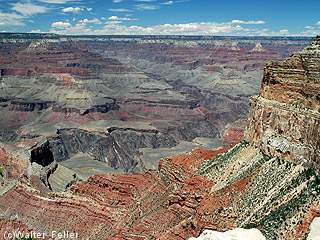
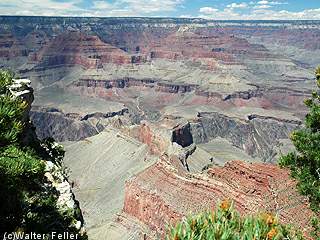
The geology visible from Mohave Point spans nearly two billion years of Earth history. Near the bottom of the canyon, dark Vishnu Schist and intrusive Zoroaster Granite form the ancient crystalline basement through which the Colorado River cuts. Above these rise towering cliffs and stepped slopes of Tapeats Sandstone, Redwall Limestone, Supai Group sandstones, and younger rim-forming Kaibab Limestone. From the overlook, these strata appear as vast horizontal bands wrapping around temples and ridges that recede toward the western canyon.
One of the overlook's distinctive features is its direct view into the Granite Gorge, where the canyon narrows and steepens around the river. In favorable light, whitewater rapids can sometimes be seen or faintly heard from below. The visible stretch of the Colorado River reinforces the scale of the landscape and the erosive power responsible for carving the canyon over geologic time.
Mohave Point also preserves traces of the canyon's early tourism era. Hermit Road itself originated during the years when stage routes, rustic camps, and early automobile excursions first brought visitors westward along the rim. Today the road is largely restricted to shuttle traffic for most of the year, allowing the overlook to remain comparatively quiet despite its popularity. The combination of accessible trails, expansive western views, visible river scenery, and exceptional sunset light has long made Mohave Point one of the defining viewpoints of the South Rim.